
“early instigators of the UK post-systems movement whose work straddles the spheres of rock, minimalism and post-punk”
At the start of the 1980s there were two British bands, Lost Jockey and Regular Music, who drew from minimal music and developed it into a more dramatic, beat-oriented style, adding amplification to a mainly classical line-up, and performing the music with energy and drive. For young composers in the 1970s it was natural to consider ways to integrate rock and jazz with classical and more experimental styles, and minimal music afforded a straightforward template, focusing on repetitive structures, simple and layered orchestration, and modular forms.
Regular Music was established through the idea of using minimal and experimental music as a springboard for new composition by its members. The founding musicians all went to Goldsmiths College – Jeremy Peyton Jones (saxophones, MD), Andrew Poppy & Helen Ottaway (both on keyboards) – joined by other performers from Goldsmiths, including Alex Kolkowski (violin) & Alex Maguire (keyboard), and then later, Maria Lamburn (viola). There was also a Royal Holloway College connection – Poppy had studied there for a year prior to transferring to Goldsmiths – and he invited Geoff Warren (saxes & flute) and Dave Powell (tuba), joined later by Mark Emerson (violin) and Jonathan Parry (piano & keyboards).
Regular Music’s early concerts took place in art galleries, arts centres, and art colleges, who seemed receptive to this new style of music. In September 1982 the group took part in the DIAL M for MUSIC series at the ICA, in a concert supporting the Michael Nyman band. At that time the repertoire included Peyton Jones’s Purcell Manoeuvres and Music for Film:
For a concert at the Air Gallery in November that year the band gave the first performance of his Idyllic Rhythms, based upon the harmonies of a passage in Wagner’s Siegfried Idyll. Jeremy said: “In the original the harmonic movement is fast and sequential and I have significantly slowed this down …The effect is to greatly increase the concentration on rich harmonies rather like holding a magnifying glass to one cadential passage…”
The same concert also saw the first performance of Jonathan Parry’s 3-part piece, Neapolitan Sixth, of which the third section, a fast number with dueling saxophones, was often used as a concert closer. Analysis of both Idyllic Rhythms and Neapolitan Sixth can be found in Parry’s YouTube lecture:
The DIAL M for MUSIC series was subtitled ‘Systems and All Sorts’ – in a radio interview at that time, Jeremy explained the label of a ‘post-systems’ band:
By this time, through several departures and arrivals, the band’s personnel had evolved, with the drummer from This Heat, Charles Hayward, joining the group to lend a very individual groove to the pieces – loose and rolling against tighter and driving ensemble textures. Bronek Szerszynski added electric guitar, and Sarah Homer played saxophone and bass clarinet, freeing Jeremy to play other instruments or to direct. Mary Phillips also played saxophone but added her pure and clear soprano voice to the group sound, a central focus of the second half of Idyllic Rhythms. Jocelyn Pook came in on violin and viola. Dave Powell’s tuba took on a vital bass register role within this expanded group sound, and later other colleagues of his from the big band Loose Tubes, Ashley Slater (trombone) and John Eacott (trumpet), joined Regular Music for specific projects.
In the same interview, Jeremy explains how the changes in personnel affected the sound and style of the group:
‘In the process of reaching out towards a definition of Regular Music’s output, one thing it most certainly wasn’t was what the name suggests – identifiable style or form. Anyway, the ensemble’s is a suspicious name dangled as a carrot to
Charles Ledesma, Performance, No.25, aug/sept 1983
catch you unaware, to subvert your tastes, your expectations, your sensibilities. This is exactly what they proceeded to do in an aural crescendo consisting of 6 pieces knitted together by Jeremy Peyton Jones and Jon Parry from a complex, colourful
fabric of influences; modern, classical, jazz & rock rhythms coupled to an avant garde mould of composition.’
1984 saw a multimedia work by Steve Littman and Peyton Jones staged at the ICA, The Long Search for the Necessary Tool, and also an Arts Council Tour of the UK, with a programme that included Gavin Bryars’ Out of Zakeski’s Gazebo, and Frederic Rzewski’s Coming Together, as well as their own pieces.

(Mary Phillips, voice; Bron Szerszynski, guitar). Image © Steve Littman
In 1985 the group went to Rheims in France for a concert ‘Musiques de Traverses’ – an early appearance of the term ‘crossover’ – and in the same year they were invited by Geoff Travis of Rough Trade to record their eponymous album, with sessions at Falconer Studios in Camden, and some remixing at Wave Studios. The album was released in 1985, and containing three pieces each from Peyton Jones and Parry, then re-released on CD by Klanggalerie in 2019.

According to the Klanggalerie liner notes, the band’s final concert performance was at the first MIMI Festival in St-Rémy-de-Provence in July 1986, but Peyton Jones continued to collaborate with experimental theatre makers in projects across the 1980s and into the 90s, using players from the band, most notably in several theatre and site-specific performance works by Lumiere & Son, directed by Hilary Westlake and David Gale. Some of this music would be recycled into concert pieces.
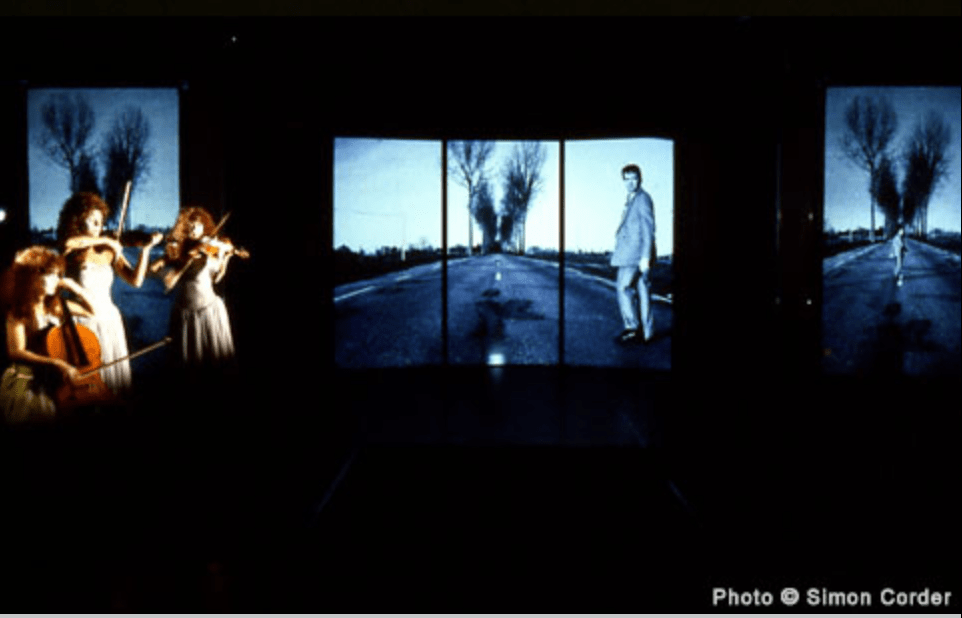
In 1991 Peyton Jones relaunched the group as Regular Music II, with another album release arriving five years later, North South East West, on Italian label New Tone Records.
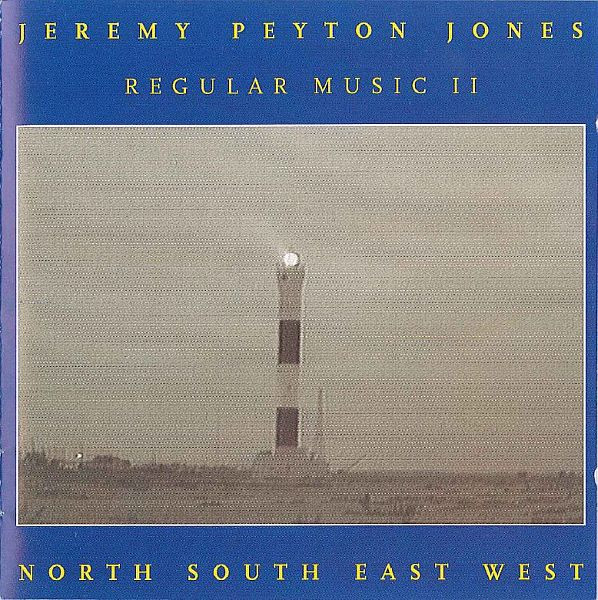
This second incarnation of the band is discussed on the Jeremy Peyton Jones website.

Ian Gardiner / Jonathan Parry
 BRITISH MUSICAL POSTMINALISM 1979-97