BRITISH MUSICAL POSTMINIMALISM 1979 – 97
A research project into UK independent art music composers and groups of the 1980s & 90s
Out of the turn of the 1980s, across that decade and into the 1990s, a young generation of British composers sought to align themselves away from the modernist position of much of the contemporary music in the UK at the time. These younger composers looked to connect with a wider set of musical styles and practices – from US and UK experimental music, minimalism, pop and jazz – but also established and wrote for their own ensembles, finding new venues, self-publishing and promoting, collaborating with postmodernist artists in other disciplines, and generating an independent and progressive art music scene, largely in London.
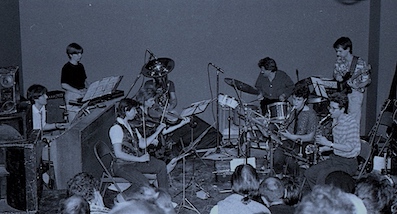
REGULAR MUSIC, LATCHMERE THEATRE 1983
This period, these groups, their music, their composers, are not well-documented or researched, although several of its key figures have subsequently followed venerable careers into concert composition, media composition, and the academy. They include: Orlando Gough, Andrew Poppy, Errollyn Wallen, Laurence Crane, Glyn Perrin, Jeremy Peyton Jones, Helen Ottaway, Jocelyn Pook, Andrew Hugill, Graham Fitkin and Steve Martland; and the groups Lost Jockey, Man Jumping, Regular Music, Ensemble X, the Steve Martland Band, Nanquidno Group, and George W Welch. The timeframe of the project delineates the period of Conservative government in the UK – analogous to what is sometimes termed ‘the long 1980s’ – a time of conflicting artistic crosscurrents but also of oppositional energy. This scene provided the seedbed for the development of the next generation of postminimal ensembles – Icebreaker, Piano Circus, Ensemble Bash, et al – and anticipated the much later developments of genre fusion, crossover, the ‘Nonclassical’ movement, that are central to much 21st century contemporary music programming.
In their early concerts, both Lost Jockey and Regular Music performed works by Riley and Glass; Man Jumping gave a performance of Reich’s Four Organs at the Almeida Festival in 1986. Common to the music of these composers was a reliance on a conveyor-belt of pulse to drive textures based on repetitive patterning, even when at slow tempo – to use Jon Pareles’ 1983 definition of musical postminimalism: ‘using repetition for texture rather than structure, and embracing sounds from jazz and the classics’. This grid-like approach to pulse and rhythm may also have had a contemporary parallel in the emergence of step-time sequencing and quantisation as a practice and concept within electronic popular music. The spirit of these groups was at the time defiantly anti-modernist, and certainly sought out an aesthetic, a space that was distanced from that of the previous generation of modernist composers and their institutions and contexts. All of these groups sought to establish a sound and a style that acknowledged alternative musical histories and lineage, sometimes challenging the barriers between “high” and “low” musical styles. However, in common with the ‘postminimal’ movement in the visual arts, the work of these composers became stylistically diverse, not only adapting and developing out of minimalism but also drawing from postmodernism and conceptualism, particularly in cross-art collaborations with theatre, dance and film.
Introduction and overview of the project
links to composers / musicians
David Owen
Glyn Perrin
links to groups
nanquidno group
useful links
Kyle Gann: A Course in Postminimalism
Unfinished Histories – UK alternative theatre in 70s & 80s
playlists
 BRITISH MUSICAL POSTMINALISM 1979-97